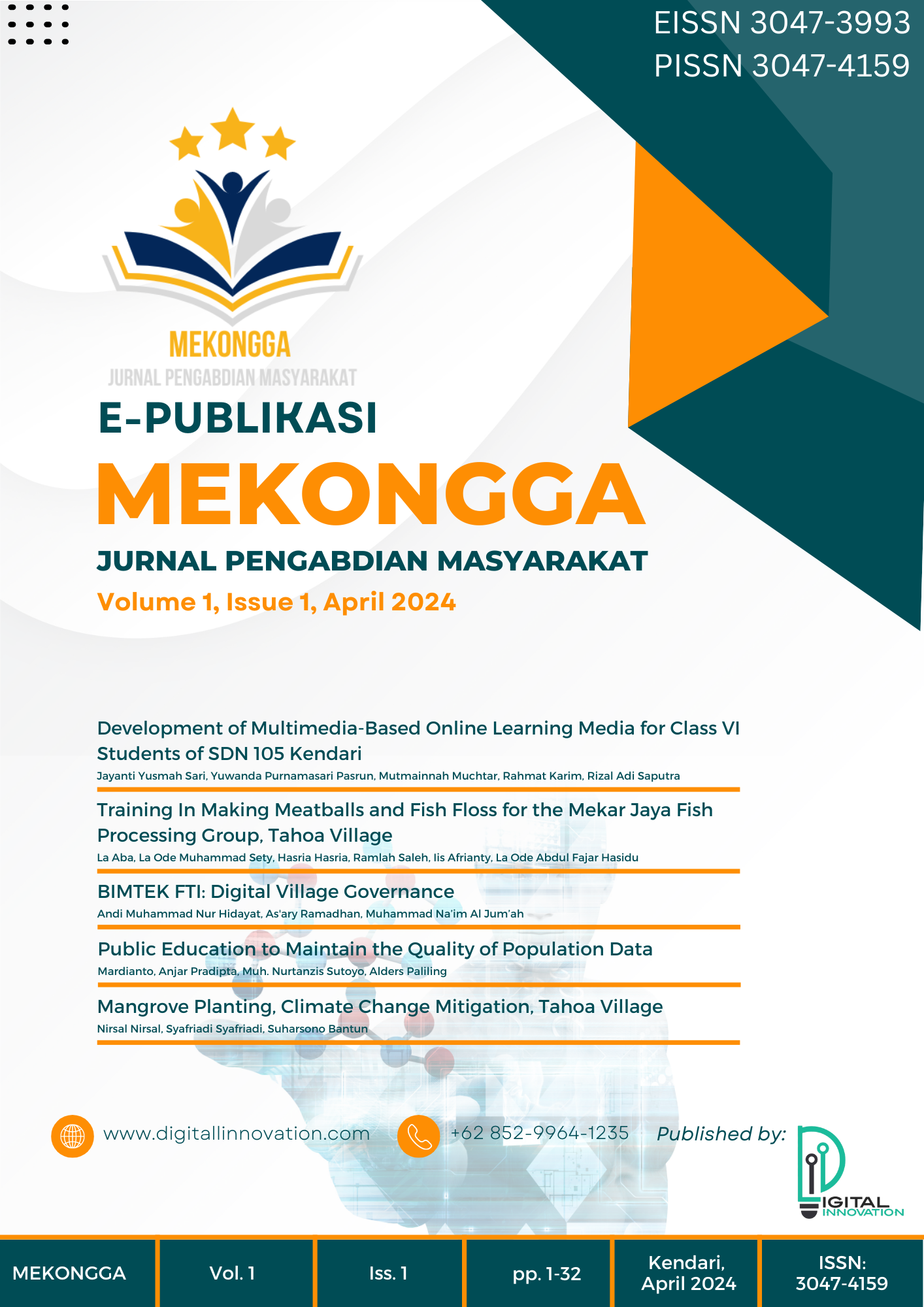
Training In Making Meatballs and Fish Floss for the Mekar Jaya Fish Processing Group, Tahoa Village
DOI:
https://doi.org/10.69616/mekongga.v1i1.172Keywords:
branding, making fish balls, Nutritional Value, TrainingAbstract
The aim and objective of this activity is to assist the Mekar Jaya fish processing company in increasing the production volume and value of the company's finished products. Increasing production and increasing product value is carried out through fish ball and shredded meatball training, branding training, collective packaging and labeling of finished products. This will make it easier to increase the volume of Mekar Jaya fish processed by the group, as well as help increase business income and expand the product market. The name of this brand is taken from the local legend of Kolaka, namely Owete means fish, and Meambo means good. The goal is that in the future this product can be known by the people of Kolaka Regency and Southeast Sulawesi as a common component of regional cuisine. The results of laboratory analysis show that the nutritional value of processed fish balls and the product itself is quite significant. The goal is, by consuming these meatballs and floss, people's nutritional needs can be met. Apart from being an effort to increase the group's fish processing capabilities and increase the selling value of the group's processed products, this activity also increases the diversification of processed fish products in Kolaka Regency and increases the capacity of the MSME cluster in Tahoa Village. Kolaka. So that in the future, similar efforts need to be encouraged again in various locations in Kolaka Regency to expand the benefits of similar activities.
References
Badan Pusat Statistik Provinsi Sulawesi Tenggara, “Kabupaten Kolaka dalam Angka tahun 2022.” [Online]. Available: https://kolakakab.bps.go.id/
S. Ramlah, H. E. Adimu, A. Asni, and L. Fekri, “Pengembangan usaha perikanan tangkap skala kecil di Kabupaten Kolaka, Sulawesi Tenggara,” J. Kebijak.Sos. Ekon. Kelaut. Dan Perikan., vol. 12, no. 1, pp. 1–10, 2022.
S. Bantun et al., “Mitigasi Bencana Pesisir: Pemberdayaan Komunitas Nelayan Sipatuo melalui Penanaman Mangrove di Kelurahan Tahoa, Kabupaten Kolaka, Sulawesi Tenggara,” Dharma Raflesia J. Ilm. Pengemb. dan Penerapan IPTEKS, vol. 21, no. 2, pp. 227–239, 2023.
F. Ismail, I. Marus, M. Irfan, R. Andriani, and F. Muchdar, “Peningkatan Keterampilan Istri Nelayan Dalam Mengelola Jenis Ikan Ekonomis Penting Dalam Pembuatan Bakso Ikan Di Desa Falabisahaya, Kecamatan Mangoli Utara,” J. Abdi Insa., vol. 10, no. 2, pp. 1137–1147, 2023.
N. Nurfadila et al., “Pemberdayaan Perempuan Melalui Pelatihan Pengolahan Ikan Lure Dan Ikan Cakalang Menjadi Produk Bernilai Tinggi Di Kampung Bajo, Kelurahan Anaiwoi, Kabupaten Kolaka,” J. Din. Pengabdi., vol. 8, no. 1, pp. 43–50, 2022.
S. Abdullah, N. I. Wianti, M. Tadjuddah, and T. Buana, “Peningkatan Ketahanan Pangan Masyarakat Nelayan Melalui Olahan Ikan Tongkol di Desa Saponda Laut Kecamatan Soropia Kabupaten Konawe Sulawesi Tenggara,” J. Pengabdi. Kpd. Masy. MEMBANGUN NEGERI, vol. 6, no. 1, pp. 127–140, 2022.
I. Widiastuti and S. Putro, “Analisis mutu Ikan Tuna selama lepas tangkap,” Maspari J. Mar. Sci. Res., vol. 1, no. 1, pp. 22–29, 2010.
F. Rahmawati, “Aneka Ragam Pengolahan Ikan,” Mater. Kegiat. Pemberdaya. Sos. untuk Kegiat. Altern. dalam Pengolah. Potensi Lokal. Kerjasama Kementeri. Pembang. Drh. Tertinggal dan Fak. Pertan. Univ. Gadjah Mada. Sumba Teng., vol. 13, p. 16, 2012.
N. P. J. Novianti and L. P. Mahyuni, “Pembuatan abon ikan untuk peningkatan nilai tambah hasil tambak ikan di desa songan, kecamatan kintamani, bali,” Din. J. Pengabdi. Kpd. Masy., vol. 5, no. 4, 2021.
H. Hasni, D. Agustyawati, D. Pardana, and A. Daholu, “Pemberdayaan Perempuan Melalui Diversifikasi Produk Ikan Menjadi Bakso Ikan untuk Meningkatkan Ekonomi Keluarga,” J. Community Empower., vol. 1, no. 2, pp. 56–61, 2022.
Published
Issue
Section
Copyright (c) 2024 MEKONGGA: Jurnal Pengabdian Masyarakat

This work is licensed under a Creative Commons Attribution-ShareAlike 4.0 International License.
This work is licensed under a Creative Commons Attribution-ShareAlike 4.0 International License. Authors retain copyright and grant Mekongga: Jurnal Pengabdian Masyarakat the right of first publication with the work simultaneously licensed under the CC BY-SA 4.0 license, allowing others to share and adapt the work with proper attribution and equal sharing of derived works.